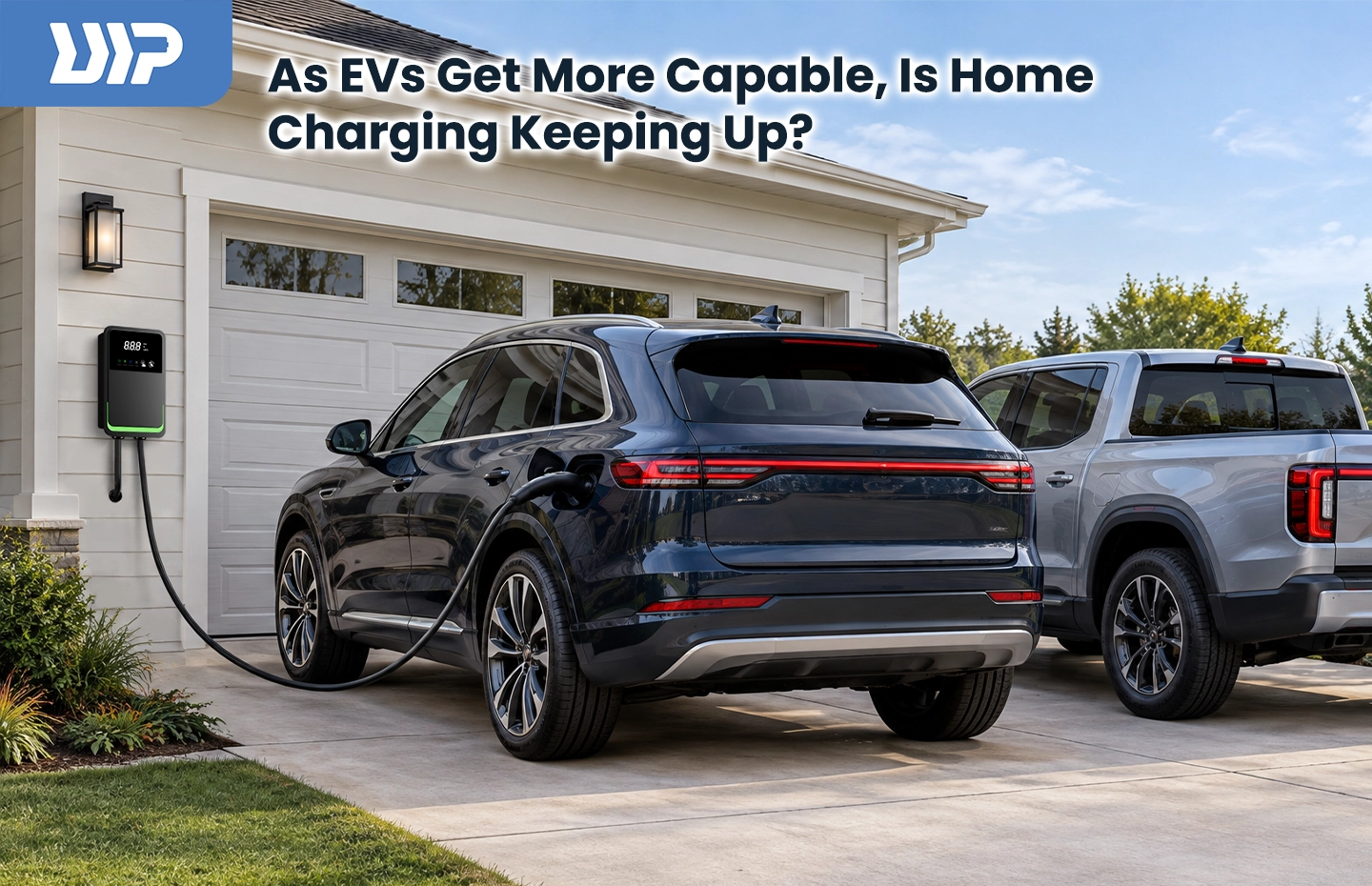

As EVs Get More Capable, Is Home Charging Keeping Up?
Introduction: Home Charging Is Becoming a More Specific Product Choice
Electric vehicles are arriving with larger batteries, longer driving ranges, and more varied charging capabilities. For the home charging market, this creates a more specific product question: how much AC charging power can a vehicle actually use, and when does a higher-output charger make a practical difference?
For many households, a conventional Level 2 charger rated at 40A or 48A can meet daily charging needs. But some electric vehicles support higher AC charging rates, making an 80A, 19.2 kW charger a relevant option for certain drivers.
The opportunity is not simply to offer more power. Vehicle compatibility, home electrical capacity, charging schedules, and ease of installation all influence whether a higher-output charger delivers meaningful value.
For EV charging brands and distributors in North America, understanding these factors can help identify where 80A charging fits into a broader home charging product portfolio.
Large-Battery EVs Are Changing the Home Charging Conversation
Battery capacity is becoming an important consideration in the North American EV market, particularly among electric pickup trucks, large SUVs, and premium models designed for longer trips or demanding driving conditions.
The 2026 Cadillac Escalade IQ, for example, has a 205 kWh battery. Ford's F-150 Lightning has also offered battery options with substantially different capacities, including a 131 kWh usable-capacity Extended Range battery in the 2023 model year.
Larger batteries can increase the amount of energy a vehicle needs between charging sessions. For drivers who cover long distances, tow, or return home with a low state of charge, the time available for overnight charging can become an important part of the ownership experience.
However, battery capacity alone does not determine how quickly an EV can charge at home. The vehicle's onboard AC charger and the power available from the home's electrical system are equally important.
This distinction creates a more segmented home charging market. Many EV owners may be well served by standard Level 2 charging, while some owners of compatible vehicles may benefit from higher AC charging power.
For product planners, the question is not whether every household needs an 80A charger. It is whether a specific customer segment has vehicles, driving patterns, and electrical installations that make the higher output worthwhile.
Battery Capacity Is Only Part of the Charging Equation
Three specifications determine how much value a driver can get from a high-power home charger:
- Battery capacity (kWh):The amount of energy the vehicle's battery can store.
- Onboard AC charger capacity (kW):The maximum AC charging power the vehicle can accept, subject to operating conditions.
- EVSE output (kW):The charging power the home charging equipment can supply, subject to its rating and the available electrical supply.
The effective AC charging rate is limited by the lowest applicable constraint. A charger rated at 19.2 kW cannot force a vehicle with an 11.5 kW onboard charger to accept 19.2 kW.
The difference matters when comparing vehicles and planning a charging product portfolio.
Consider a vehicle with a large battery but an 11.5 kW onboard charger. Connecting it to an 80A EVSE does not make it charge at 19.2 kW. By contrast, a compatible vehicle with a 19.2 kW onboard charger may be able to use the higher output when the installation can supply it.
That is why high-power home charging should be evaluated through vehicle specifications rather than battery size alone.
Which EVs Support 19.2 kW AC Home Charging?
Some North American EV models have offered 19.2 kW onboard AC charging, either as standard equipment on particular trims or as an option. Availability varies by model year and configuration, so buyers should check the specifications for the exact vehicle.
|
EV model |
Relevant AC charging detail |
|
Cadillac Escalade IQ (2026) |
Cadillac lists up to 19.2 kW onboard AC charging for Premium Luxury and Premium Sport trims; other trims have different maximum AC charging rates. |
|
Ford F-150 Lightning |
The Extended Range configuration was listed with a 19.2 kW onboard charger. |
|
Porsche Taycan |
Porsche has offered an optional 19.2 kW onboard AC charger upgrade on applicable model configurations. |
|
Chevrolet Equinox EV |
Chevrolet has an available 19.2 kW Level 2 AC charging option. |
These examples show why 19.2 kW charging is a relevant product category, but they do not mean every large-battery EV supports this rate. Model year, trim, optional equipment, and market configuration all matter.
For distributors and charging brands, compatibility is a useful starting point for identifying potential customers for 80A home charging products.
What Does an 80A, 19.2 kW EV Charger Offer?
At 240V, an 80A charger can deliver up to 19.2 kW:
240V × 80A = 19,200W, or 19.2 kW
For comparison, a 48A charger at the same voltage provides up to 11.52 kW. The 80A unit therefore offers approximately 67% more maximum output, provided the vehicle and installation can support it.
The difference can be illustrated with a simple calculation:
|
Charger output |
Theoretical energy delivered in 4 hours |
|
7.7 kW |
30.8 kWh |
|
11.5 kW |
46 kWh |
|
19.2 kW |
76.8 kWh |
These figures represent theoretical energy delivery at a constant rated output. Actual charging results vary with charging losses, vehicle limits, temperature, battery conditions, and power adjustments.
The practical benefit is straightforward: when a compatible EV can accept 19.2 kW, an 80A charger can deliver more energy during a limited parking window than a lower-output unit.
That may matter to drivers with large batteries, high daily energy use, or limited time between trips. It is less compelling for households whose vehicles are already fully charged during their usual overnight parking period.
ULandPower offers high-output Level 2 charging options through its UN1 80A EV charger range and UN2 80A Level 2 charger range. These product lines provide a starting point for brands exploring 19.2 kW charging options, with connector, configuration, and intended application to be confirmed for each model.
Why Charging Power Matters for Daily Driving
The value of higher charging power becomes clearer when the energy required by a vehicle is considered alongside the time it spends parked.
Suppose a driver needs to replenish 60 kWh after a long day on the road. At a constant 11.5 kW, delivering that amount would take approximately 5.2 hours. At 19.2 kW, the theoretical time falls to about 3.1 hours.
These estimates exclude charging losses and changes in power during charging, but they illustrate the potential difference.
For a driver who arrives home late and leaves early, a shorter charging window can make higher AC output useful. It can also provide more flexibility when a vehicle is used frequently throughout the day.
However, charging speed is only one part of the decision. If a vehicle cannot accept more than 11.5 kW AC, or if it routinely sits parked for eight to ten hours overnight, the additional charger capacity may provide little day-to-day benefit.
The right product choice depends on the vehicle, the driver's schedule, and the available electrical capacity—not just the highest number on the charger's specification shee
The Electrical Installation Can Determine Whether 80A Is Practical
An 80A EV charger needs more than a compatible vehicle. The home's electrical installation must also be able to support the load.
EV charging is generally treated as a continuous load under North American electrical codes. An 80A charging load commonly requires a 100A branch circuit under the applicable continuous-load sizing rules, but the actual installation must follow local code requirements, equipment instructions, conductor ratings, and the electrician's assessment.
Some homes may have sufficient electrical service and a suitable installation path. Others may require additional work or a different charging solution.
This is especially relevant in homes where other high-demand equipment—such as electric heating, air conditioning, ranges, or hot tubs—may operate at the same time as the EV charger.
Before choosing an 80A unit, homeowners should have a qualified electrician assess the service capacity, circuit requirements, wiring, and installation conditions.
For charging brands and distributors, this creates a clear product-planning consideration: high-output charging should be presented as an option for suitable installations, not as a universal replacement for 40A or 48A home chargers.
How Can High-Power Home Charging Work with Household Energy Use?
Having enough electrical capacity is only part of the equation. In some homes, managing how that capacity is used can be just as important.
When an EV charger operates alongside air conditioning, a heat pump, or other major household loads, the combined demand can become a concern. Dynamic load management can adjust charging current according to the system's measured electrical load, helping coordinate EV charging with other household consumption.
This does not eliminate the need for a suitable electrical installation, nor does it mean every home can support an 80A charger without electrical upgrades. Its effectiveness depends on the system design, compatible equipment, and installation conditions.
Other features address different needs. Scheduled charging can help drivers align charging with off-peak electricity rates where available. Solar-priority charging can adjust charging behavior according to available solar generation in a compatible system.
These functions should not be treated as interchangeable. Load management coordinates electrical demand; scheduled charging changes when charging takes place; solar-priority charging responds to available solar energy.
ULandPower's EnerSync home energy management solution supports functions including whole-home load management, solar-priority charging, and multi-charger power sharing, depending on the system configuration. These capabilities can be relevant when planning charging solutions for homes with more complex energy requirements.
For product developers, the broader point is that charging value can come from both output power and how intelligently that power is managed.
Beyond Charging Power: Thermal Design, Safety, and Reliability
An 80A EV charger can deliver up to 19.2 kW at 240V, making thermal management an important part of product design. Sustained high-current operation generates heat, and effective heat dissipation helps keep operating temperatures under control, supporting reliable performance and helping protect components under specified operating conditions.
ULandPower's UN1 and UN2 high-power charging platforms feature optimized thermal design and offer 40A, 48A, and 80A configurations. A single hardware platform supports both NACS and J1772 through interchangeable cable options. The U-Flow App provides additional charging control options. For OEM partners, ULandPower supports a wide range of customization options, including product design, hardware configuration, software functionality, branding, and packaging, helping partners adapt products to their target markets and business requirements.
Explore the UN1 EV charger range and UN2 EV charger range for available configurations.
What Does This Mean for EV Charging Brands and Distributors?
What Does This Mean for EV Charging Brands and Distributors?
The development of larger-battery EVs and higher onboard AC charging capability creates an opportunity to offer more specific home charging products. But it does not make 80A charging the right choice for every customer.
For product planning, three considerations are particularly useful.
First, match charger output to vehicle capability. A 19.2 kW EVSE is most relevant to vehicles that can accept that level of AC power. Vehicle compatibility should be checked by model year and configuration.
Second, account for the installation environment. Electrical capacity, circuit requirements, and the need for load management can determine whether an 80A solution is practical for a particular household.
Third, build a portfolio for different customer needs. A 40A or 48A charger may suit many everyday charging scenarios, while an 80A option can address customers with compatible vehicles, higher energy requirements, and suitable installations.
For charging brands and distributors, this is where OEM/ODM partnerships can help. Working with a manufacturer that supports product configuration, branding, and technical adaptation can make it easier to build a range around distinct market requirements.
ULandPower provides EV charger OEM/ODM support for partners planning products for different charging applications and target markets. The UN1 and UN2 80A ranges are relevant starting points for businesses evaluating high-output Level 2 charging products for North America.
Explore the UN1 80A charger and UN2 80A charger to review available configurations and discuss product requirements.
Conclusion: Match Charging Capability to Real Demand, Not Just Higher Power
Larger-battery EVs and vehicles with higher onboard AC charging capability are making 19.2 kW home charging a more relevant option for specific customer segments in North America.
An 80A charger can deliver more energy in a given period than a conventional 48A unit, but the benefit depends on whether the vehicle can accept the additional power, whether the home electrical installation can support it, and whether the driver's routine makes faster AC charging useful.
For charging brands and distributors, the opportunity is not simply to move toward higher amperage. It is to offer the right combination of charging output, installation compatibility, energy management, and user experience for different customers.
Looking to expand your Level 2 charging portfolio? Explore ULandPower's UN1 and UN2 80A charger ranges, or contact ULandPower to discuss OEM/ODM requirements for your target market.