How ULandPower VTS Gives OEM/ODM Customers Visibility Across the Production Process
For OEM/ODM customers, managing an EV charger order does not end when production begins. As order volumes grow, it becomes more difficult to keep track of production progress and the records associated with individual units. For overseas customers, who cannot stay at the factory throughout production, this information is often communicated through emails, photos or manual updates.
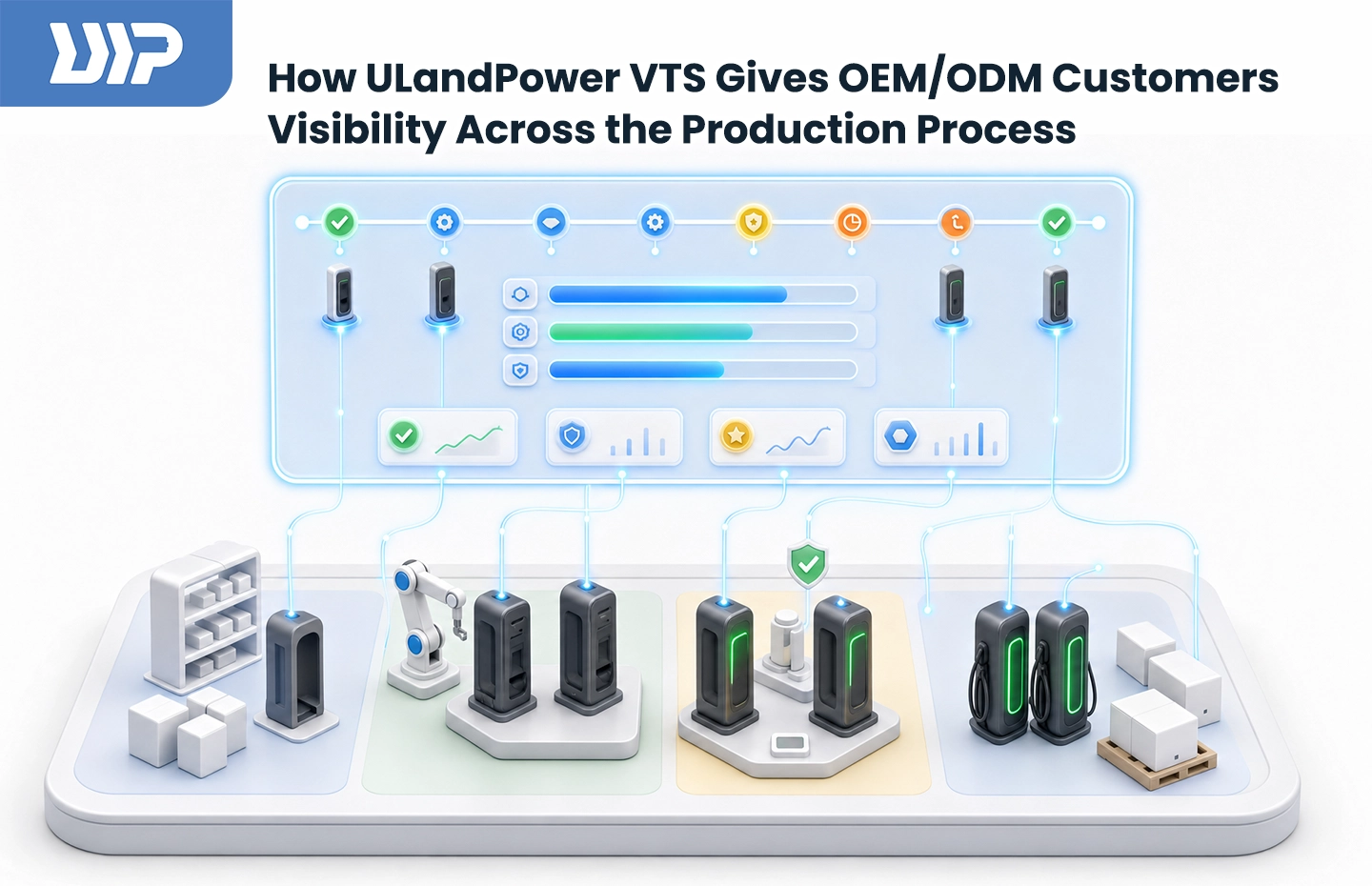
ULandPower VTS (Visual Traceability System) provides a more direct way to follow production. Customers can access production information through a dedicated order link without additional registration or login. At the order level, they can follow production progress; at the product level, serial numbers connect individual chargers with their production and test records.
For large-volume OEM/ODM orders, this visibility becomes particularly valuable. Customers do not have to rely entirely on manual updates to understand where an order stands. They can view production information through VTS and trace individual products by their serial numbers when needed.
What Can OEM/ODM Customers See During Production?
Once an order enters production, customers can access production information through a dedicated order link without additional registration or login. This gives customers a more direct view of how the order is progressing without relying entirely on manual updates from the factory.
At the order level, VTS can show:
- 1.Total order quantity
- 2.Completed quantity
- 3.In-production quantity
- 4.Completion percentage
- 5.Estimated delivery time
- 6.Daily production output trends
These figures help customers understand the current status of the order and how production is progressing.
VTS also provides visibility at the individual product level. Each charger can be identified by its serial number (SN), allowing customers to see its current production stage and access the production and test records associated with that unit.
Why Does VTS Become More Valuable as Order Volume Grows?
As the number of EV chargers in an order increases, keeping track of production status and individual product records becomes more difficult. A small order may be relatively easy to follow through regular updates, but larger orders involve more units, more production records and more test information to manage.
VTS connects order-level production information with individual product records, giving customers a structured way to follow larger-volume production. Instead of relying on separate emails, spreadsheets or manual updates to understand the status of an order, customers can view production information through the dedicated order link and trace individual units by their serial numbers.
This becomes particularly useful for OEM/ODM customers managing hundreds or thousands of chargers. They can follow the overall progress of the order without losing visibility of individual products, and retrieve the corresponding production and test records when needed.
From Order-Level Visibility to Individual Product Traceability
For large-volume orders, knowing the overall production progress is only part of the picture. Customers may also need to identify and review a specific charger within the order. This is where serial number (SN) traceability becomes important.
Each charger can be associated with its SN and corresponding production information. Depending on the product and production setup, the records may include production time, production stage, software or firmware version, relevant material information, and inspection or final test status.
This creates a connection between the overall order and an individual unit:
Order > Product SN > Production Process > Production and Test Records
For OEM/ODM customers, this means that production information does not remain only at the batch level. Individual units can be identified and their associated records can be traced when needed.
How Are EV Charger Test Records Connected to Each Product?
Testing is an important part of EV charger production, but a test result is more useful when it can be linked to the specific unit that was tested. Through the product serial number, VTS can associate available factory and ATE test information with the corresponding charger.
Depending on the testing setup, these records can include the test item, test criteria or basis, actual measured values, and PASS/FAIL results. This allows customers to review the test information associated with an individual unit rather than relying only on an overall batch result.
For OEM/ODM customers managing large orders, this product-level connection provides a clearer record of what was tested and the result associated with each charger.
What Happens When a Product Needs to Be Investigated?
When a specific EV charger needs to be investigated, the serial number provides a starting point for reviewing its production history. Instead of checking an entire order, customers and the production team can identify the individual unit and review the records associated with it.
Depending on the product and production setup, these records may include its production time, production stage, software or firmware version, and available factory or ATE test results. This information can help the production and quality teams understand what happened to the unit during manufacturing and support further investigation.
VTS does not automatically determine the root cause of a quality issue. Its role is to provide traceable production and test information that can be used as evidence during investigation and follow-up.
How Does VTS Complement Certification and Quality Management?
Product certification, quality management and manufacturing traceability provide different types of information to OEM/ODM customers.
|
Evidence |
Question it answers |
|
Product certification |
Does the product meet requirements within the certificate's scope? |
|
Quality management system |
How are manufacturing and quality processes managed? |
|
Factory audit |
What facilities and processes does the manufacturer operate? |
|
VTS production records |
What production and testing information is associated with this order or charger? |
VTS does not replace product certification, quality management systems, factory audits or independent testing. Instead, it provides greater visibility into production and creates a way to trace information associated with individual products.
What Does ULandPower VTS Mean for OEM/ODM Customers?
For OEM/ODM customers, especially those managing large-volume EV charger orders, production visibility becomes increasingly important as the number of units grows. VTS brings order-level production information and product-level records into one connected system, making it easier to follow an order and trace individual chargers when needed.
Customers can use a dedicated order link to view production information during manufacturing, without additional registration or login. At the product level, serial numbers connect individual chargers with their production and test records, providing a traceable record that can be referenced during quality investigation or follow-up.
The value of VTS is not simply having more production data. It is having a clearer way to understand where an order stands, identify individual products and access the records associated with them throughout the manufacturing process.
FAQ
What is ULandPower VTS?
ULandPower VTS (Visual Traceability System) is a digital system that connects order information, production processes, product serial numbers, and production and test records, helping OEM/ODM customers gain greater visibility into EV charger production.
Can OEM/ODM customers view production information during manufacturing?
Yes. Customers can access production information through a dedicated order link without additional registration or login. The information available can include order progress, production quantities, completion percentage, estimated delivery time and individual product status.
Is VTS useful for large-volume EV charger orders?
Yes. As order volume increases, managing production status and individual product records becomes more complex. VTS connects order-level information with individual product records, making larger-volume orders easier to follow and trace.
Can an individual EV charger be traced by its serial number?
Yes. The serial number can be used to identify an individual charger and trace its associated production and test records. The specific information depends on the product and production setup.
What test information can be traced through VTS?
Depending on the testing setup, VTS can associate factory and ATE test information with the corresponding product. Records can include test items, test criteria or basis, actual measured values and PASS/FAIL results.
Does VTS replace product certification or factory audits?
No. VTS complements product certification, quality management systems, factory audits and independent testing by providing production information and product-level manufacturing and test records.
About ULandPower
Founded in 2022, ULandPower is an EV charging equipment manufacturer providing EV charger OEM and ODM solutions for global markets.
ULandPower provides AC and DC charging products for distributors, charging operators, fleet and property applications, and other business partners. With manufacturing and R&D operations across China, Thailand and Poland, ULandPower supports customers in more than 50 countries and regions.
ULandPower combines in-house manufacturing, dedicated R&D and quality teams, white-label EV charger solutions, and digital production management capabilities such as VTS to support consistent production and traceability for OEM/ODM customers.
See How VTS Works for Your Production
Want to see how production information can be managed and traced for your EV charger orders?
Contact ULandPower to request an online VTS demo and explore how it can support your OEM/ODM production management.
Table of Contents >
- 1. What Can OEM/ODM Customers See During Production?
- 2. Why Does VTS Become More Valuable as Order Volume Grows?
- 3. From Order-Level Visibility to Individual Product Traceability
- 4. How Are EV Charger Test Records Connected to Each Product?
- 5. What Happens When a Product Needs to Be Investigated?
- 6. How Does VTS Complement Certification and Quality Management?
- 7. What Does ULandPower VTS Mean for OEM/ODM Customers?
- 8. FAQ
- 9. About ULandPower