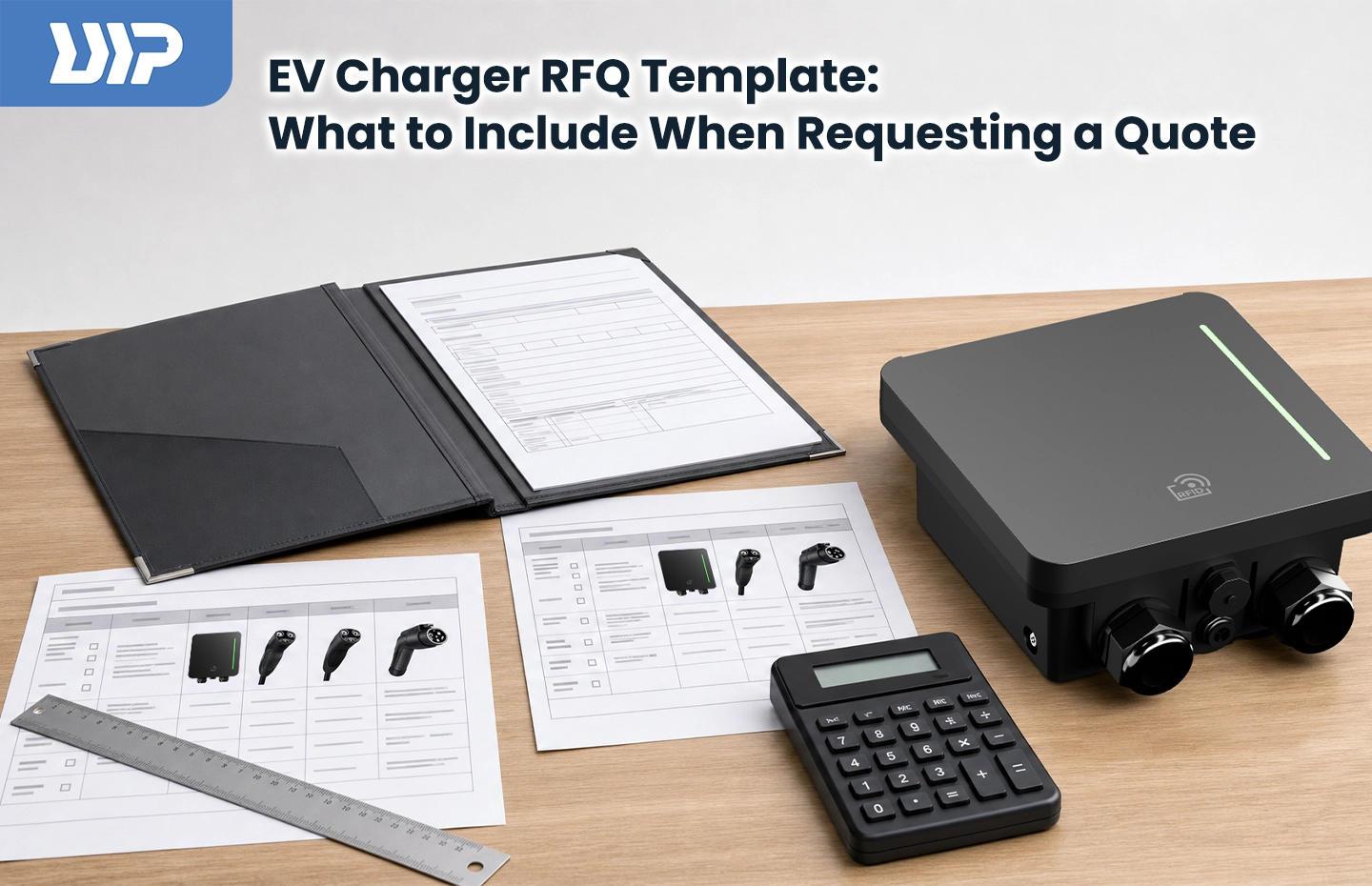
EV Charger RFQ Template: What to Include When Requesting a Quote
A good EV charger request for quotation makes every supplier price the same product, market, evidence package, services, and commercial assumptions. A vague request usually produces quotes that look comparable but hide different connector versions, software scope, certification gaps, packaging assumptions, or after-sales obligations.
Use the template below as a working brief. Fill the buyer and project fields first, mark unknown items as “to be confirmed,” and ask the OEM to identify every assumption, exclusion, deviation, and customer-supplied item in its response. Requirements vary by destination market and exact configuration, so the RFQ should request evidence and applicability rather than assume one universal certification pack.
Key takeaways: An RFQ is a control document. It should let you compare like with like, expose missing scope before sampling, and turn the winning quote into a usable baseline for design review, pilot production, and purchase orders.
What an EV Charger RFQ Must Define
Define the commercial decision before writing the specification. State whether you need a complete-unit OEM/ODM partner, a white-label product, a custom enclosure and firmware package, or a standard product with buyer branding. A supplier can only quote responsibly when the product boundary and the destination market are clear.
|
RFQ block |
What to state |
Why it matters |
|
Project and buyer |
Company, role, application, countries, launch stage, decision date, and quote contact |
Prevents a generic catalog response and identifies who owns technical and commercial approval |
|
Market and compliance |
Destination countries, grid rules, installation environment, required marks, utility or tender requirements |
Determines which tests, declarations, labels, and local approvals are relevant |
|
Product definition |
AC or DC, rated power, input, output, connector, enclosure, cable, user interface, and options |
Creates a single hardware baseline for every supplier |
|
Digital scope |
Network, OCPP version, backend, APIs, smart charging, firmware updates, payment, RFID, and app responsibilities |
Separates charger hardware price from platform and integration work |
|
Evidence and quality |
Drawings, datasheets, reports, samples, factory controls, traceability, and change control |
Makes technical claims auditable before a volume order |
|
Commercial baseline |
Forecast, MOQ assumptions, tooling, packaging, lead time, Incoterms, warranty, spares, and quote validity |
Exposes total cost and supply risk behind the unit price |
Copy Paste EV Charger RFQ Template
Send the following fields as a spreadsheet or structured document. Keep the buyer requirement in one column and ask the supplier to answer in another so deviations remain visible.
1. Buyer and project information
Company name; buyer role; end customer or channel; application (home, workplace, fleet, public, depot, destination charging); target countries; project stage; required quotation date; technical and commercial contacts.
2. Market and regulatory requirements
List each destination market and the required safety, EMC, radio, metering, labeling, accessibility, cybersecurity, data, and installation requirements. Ask the supplier to state the applicable standard edition, certificate holder, covered model, manufacturing site, and any customer-side approval.
3. Charger architecture and rating
AC or DC; single-phase or three-phase; nominal input voltage and frequency; rated output power; adjustable current; number of ports; simultaneous charging behavior; standby consumption; efficiency target; indoor or outdoor use.
4. Connector and cable configuration
Connector standard; socket or fixed cable; cable length and cross-section; cable management; locking; holster; vehicle communication requirements; regional variants; spare connector policy.
5. Enclosure and installation
Dimensions and weight targets; wall, pedestal, or site-specific mounting; IP and IK targets; operating and storage temperature; humidity; altitude; corrosion or UV exposure; ingress protection assumptions; service access; color, logo, label, and finish.
6. Communications and backend
Ethernet, Wi-Fi, cellular, Bluetooth, or other interfaces; SIM responsibility; supported protocol version; backend URL and certificate handling; API needs; remote diagnostics; offline behavior; time synchronization; firmware update method. Ask whether the supplier means protocol support, compliance testing, or an OCA certification.
7. Smart charging and energy management
Load balancing method; dynamic current limits; site meter or CT integration; solar or battery interaction; schedules; demand response; phase balancing; fallback behavior when communications fail; installer configuration tools.
8. User, payment, and metering functions
RFID; display or indicators; buttons; QR or payment terminal; local authorization; user messages; energy meter class; MID or other revenue-metering need; tariff and billing ownership; privacy and data retention requirements.
9. Software and customization
Branding; enclosure changes; boot screen; language pack; mobile app; cloud portal; APIs; firmware features; cybersecurity support; source-code or escrow expectations; acceptance criteria; ownership of customer-specific work.
10. Packaging and documentation
Individual and master packaging; palletization; drop-test expectations; labels and serial-number format; installation guide; user guide; service manual; carton artwork; languages; QR codes; spare parts list; recycling or import marks.
11. Samples, testing, and production approval
Engineering sample quantity; sample configuration; test plan; laboratory reports; pilot quantity; golden sample; factory acceptance test; inspection level; production test records; calibration evidence; change-notification period.
12. Quality and traceability
Quality system evidence such as ISO 9001 where relevant; incoming, in-process, and final inspection; serial traceability; critical component list; failure analysis; corrective action; factory audit access; subcontractor controls; nonconforming product process.
13. Forecast and commercial assumptions
Initial order quantity; 12-month forecast; annual volume scenarios; MOQ by model and color; tooling or NRE; sample and engineering charges; production lead-time assumptions; capacity reservation; warranty proposal; service parts; RMA process; training; quote validity.
14. Logistics and contract terms
Preferred Incoterm; shipping origin; carton and pallet data; export documents; payment proposal; currency; taxes and duties; insurance; delivery split; title and risk transfer; confidentiality; intellectual property; termination and change-order rules.
15. Supplier response format
Ask the supplier to return a compliance matrix with columns for requirement, response, deviation, evidence reference, one-time cost, recurring cost, lead-time impact, and owner. Require a signed assumptions and exclusions page.
How to Compare EV Charger Quotes
Normalize the response before choosing the lowest unit price. Put each supplier on the same configuration, destination, quantity, packaging basis, and software scope. Then score the evidence and risk that sit behind the price.
- Map every deviation to a cost, schedule, approval, or customer-experience impact.
- Separate one-time engineering, tooling, certification, and integration costs from recurring unit and service costs.
- Verify that certificates, reports, and declarations cover the quoted model, hardware revision, firmware configuration, label, and production site.
- Compare sample acceptance criteria and production tests; a detailed test record can reduce commissioning and warranty risk.
- Ask what happens when a component becomes obsolete, a standard changes, or a software dependency is discontinued.v
RFQ Red Flags
Treat the following as questions to resolve, not automatic proof of poor quality: a quote with no model revision; certificates shown only as logos; “OCPP certified” without an issuer or version; an undefined cloud or app scope; no exclusions page; a lead time with no quantity basis; a warranty with no RMA process; or a price that assumes the buyer will supply undocumented components or approvals.
How to Send an RFQ to ULandPower
Send the completed brief with the target market, charger type and power, quantity scenario, connector, network and backend needs, customization boundary, required evidence, and desired sample stage. ULandPower works with B2B EV-charger OEM/ODM, white-label, and complete-unit projects, with manufacturing operations in China and Thailand. The practical next step is a requirement review that separates standard product scope, customer-specific engineering, evidence to be confirmed, and items outside the equipment supply boundary.
Procurement note: Do not treat a supplier’s completed matrix as a contract by itself. Convert accepted requirements, evidence references, commercial assumptions, and change-control rules into the purchase specification and agreement.
FAQs
What is an EV charger RFQ?
It is a structured request that defines the product, market, evidence, services, quantities, and commercial assumptions a supplier must price and answer.
How detailed should an EV charger RFQ be?
Detailed enough to fix the comparison baseline, while marking open decisions clearly. Include acceptance criteria and ask the supplier to list assumptions instead of silently filling gaps.
Should an RFQ include certifications?
Yes. State the target market and required evidence, then ask the supplier to confirm applicability to the exact model and configuration. A logo alone is not evidence.
Can I ask one OEM to quote several markets?
Yes, if each market is separated in the compliance matrix. The same charger may require different labels, radio approvals, metering evidence, or installation documentation.
Should OCPP certification be mandatory?
Define the protocol version and interoperability test evidence needed for your project. Distinguish protocol support or compliance from certification issued by the Open Charge Alliance.
What should happen after the RFQ?
Review clarifications, approve the compliance matrix, evaluate samples against written criteria, and carry accepted requirements into the purchase specification and change-control process.