
How HEMS EV Charging Helps UR3 Adapt to Household Demand
Introduction
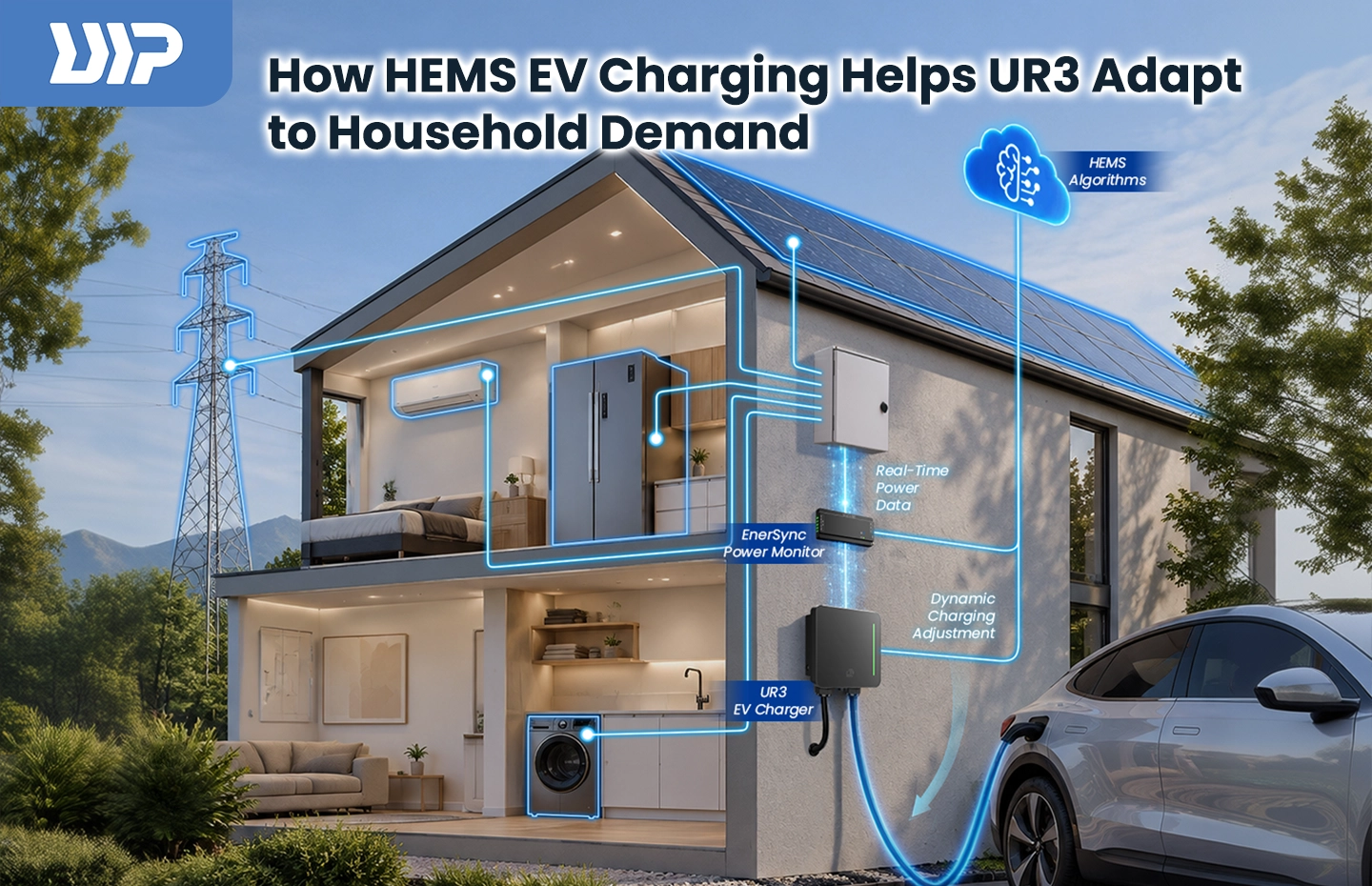
HEMS-powered EV charging uses household electricity data to inform how a vehicle charges. With the optional EnerSync Power Monitor, the ULandPower UR3 Smart Level 2 EV Charger uses HEMS algorithms to analyze available capacity and dynamically adjust its charging current as household demand changes.
That matters because a home does not use a constant amount of electricity. Air conditioning, kitchen appliances and other equipment switch on and off throughout the day. An EV charger shares the available electrical capacity with those loads, so a charging plan benefits from understanding what the rest of the home is using.
For charging brands, distributors and installers evaluating residential solutions, the useful question is how monitoring, analysis and charging control work together. UR3 provides a practical example of that relationship.
What HEMS means for home EV charging
HEMS stands for Home Energy Management System. In the UR3 charging application, HEMS algorithms use real-time household load data supplied by the optional EnerSync Power Monitor to determine the electrical capacity available for EV charging. UR3 then adjusts its charging current in response.
The roles are distinct. EnerSync provides the measurements, the HEMS algorithms analyze available capacity, and UR3 carries out the charging adjustment. This makes the relationship between the monitor and the charger central to the proposed solution.
Why a charging schedule does not describe household demand
A charging schedule sets when charging should take place. Dynamic load management addresses how much capacity is available while charging takes place. These functions answer different questions and can be considered separately when evaluating a home charging solution.
An evening start time, for example, does not tell the charger whether an oven or air conditioner is operating at that moment. Live household load data adds that context. It gives the charging system information about changing demand rather than relying only on a predetermined time or current setting.
Charging functions compared
|
Function |
Main question |
Information used |
|
Scheduled charging |
When should charging take place |
A selected charging time or schedule |
|
Dynamic load management |
How much capacity is available now |
Real-time household load data |
|
Solar charging |
How can available solar energy be prioritized |
The solar charging configuration and available solar energy |
How EnerSync and UR3 turn load data into charging adjustments
The UR3 configuration follows a three-stage process: household power monitoring, available-capacity analysis and dynamic charging adjustment. Each stage has a specific role in connecting conditions in the home with the current allocated to EV charging.
1 EnerSync monitors household electricity use
The optional EnerSync Power Monitor supplies real-time household load data. This provides a view of demand beyond the EV charger itself.
2 HEMS algorithms analyze available capacity
The algorithms use the household load data to determine the capacity available for EV charging. Monitoring information becomes an input to charging control.
3 UR3 adjusts its charging current
UR3 dynamically adjusts charging current as household demand changes. The result is charging that responds to the electrical conditions of the home.
An example of charging during a busy evening
Imagine an EV connected to UR3 while the home is using relatively little electricity. Later, cooking appliances and air conditioning begin operating, increasing household demand. EnerSync supplies the changing load data, and the HEMS algorithms reassess the capacity available to the vehicle.
UR3 can then reduce its charging current as available capacity decreases. When appliances switch off and more capacity becomes available, the charging current can increase again within the configured charging limits and the limits of the connected vehicle.
In this example, EV charging responds to the home it shares. The practical benefit is coordination between vehicle charging and other household demand. Dynamic allocation works with available capacity; it does not increase the capacity of the electrical service.
How solar charging fits into home energy management
UR3 also supports solar charging to prioritize available solar energy for the vehicle. For a home with solar generation, this adds an energy-source consideration alongside the question of how much electrical capacity is available for charging.
The distinction is useful: household load management responds to changing demand, while solar charging supports the use of available solar energy. A proposal should identify the configuration needed for the intended solar charging arrangement, including the relevant monitoring and system compatibility.
Solar availability varies, so the presence of a solar charging function alone does not determine how much of a vehicle’s charging energy will come from solar. That depends on the installation, generation conditions and when the vehicle is connected.
What brands distributors and installers should evaluate
For a charging brand or distributor, a clear equipment package makes the capability easier to explain. UR3 is the charger, while EnerSync is the optional monitoring device used in the real-time household-load configuration described here. Product pages, quotations and sales materials should make that relationship visible.
Installers should establish the home’s electrical conditions and the intended charging behavior before selecting the configuration. Relevant questions include whether whole-home load monitoring is needed, which charging limits apply, and whether solar charging is part of the project. Electrical design and installation still require an appropriate site assessment.
Demonstrating the solution should also follow its actual data flow. Show the household load changing, explain the available-capacity analysis, and show the corresponding charging-current adjustment. This gives buyers a concrete way to understand the function without relying on a broad claim that the charger is simply “smart.”
For a residential product offering, the decision is therefore about the complete charging arrangement: the charger, the monitoring option and the household conditions it is intended to serve.
Frequently asked questions about HEMS EV charging
Does UR3 need EnerSync for real-time household load adjustment
The household-load-based configuration described in this article pairs UR3 with the optional EnerSync Power Monitor. EnerSync supplies the real-time load data used by the HEMS algorithms to analyze available capacity and inform charging-current adjustments.
Is HEMS the same as dynamic load management
HEMS is the broader home energy management concept. Dynamic load management is the specific charging function discussed here: using household load data to adjust the capacity allocated to the EV. In the UR3 application, HEMS algorithms support that adjustment.
How does household load management affect charging time
Charging current can decrease as other household loads rise, so available charging power can vary during a session. The time needed to reach a target charge depends on household demand, configured limits, vehicle capability and the energy required. The purpose is to adapt charging to available capacity.
Does dynamic adjustment always deliver the highest charging current
No. When household demand increases, less capacity may be available for the vehicle and charging current may decrease. When more capacity becomes available, current may increase within the configured system limits and the connected vehicle’s limits.
Can UR3 prioritize solar energy for EV charging
UR3 supports solar charging to prioritize available solar energy. The intended installation and solar charging configuration should be confirmed for the project. The solar contribution depends on the available generation and when the vehicle is connected for charging.
Does dynamic load management remove the need for an electrical assessment
No. Dynamic load management allocates available capacity; it does not add electrical service capacity. The installer still needs to assess the site, establish appropriate charging limits and confirm the equipment configuration for the intended household and solar charging requirements.
Plan a UR3 home charging configuration
If your residential charging offering needs to respond to real-time household demand, discuss UR3 and the optional EnerSync Power Monitor with ULandPower. Start with the target market, the home’s electrical conditions and any solar charging requirements so the proposed configuration matches the application.