How EV Charging Stations Increase Property Value and Occupancy
Introduction
Every capital improvement a property owner makes is judged against one question: does it pay for itself? For years, EV charging sat in the "nice-to-have amenity" column next to bike storage and a dog wash station. That math has changed. As EV ownership moves from early adopters into the mainstream rental and buying population, charging infrastructure is starting to behave less like an amenity and more like a yield-generating asset, one that shows up in net operating income, in appraised value, and in how fast a unit leases.
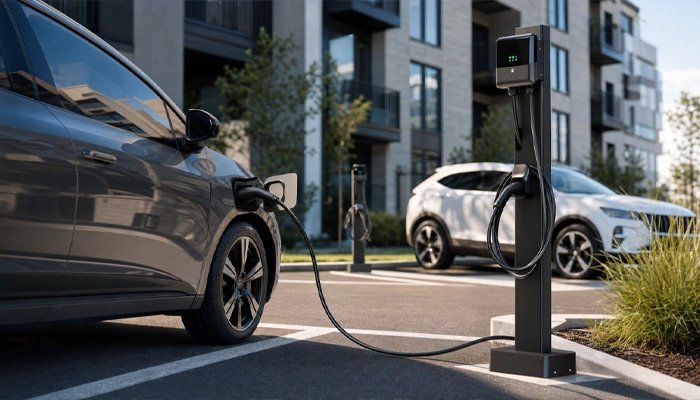
This article breaks down what the data actually shows about EV charging's effect on property value and occupancy across multifamily and commercial real estate, and how owners and asset managers can model the impact for their own portfolios.
The Property Value Case: What the Research Shows
The most rigorous evidence on EV charging and property values comes from a peer-reviewed study in Nature Sustainability, which analyzed nearly 14 million California housing transactions from 1993 to 2021. Using a hedonic pricing model, the standard real estate economics method for isolating the value of a single property feature, researchers found that proximity to public EV charging infrastructure is consistently capitalized into sale prices.
|
Key Finding: The Hedonic Pricing Premium • Homes within 1 kilometer (0.6 miles) of an EV charging station sold for an average of 3.3% more, about $17,212, than comparable homes without nearby charging access. • The premium was even larger for homes 0.4–0.5 km from a charger: a 5.8% increase over homes with no proximate charging. • Source: Liang, Qiu, Liu, He & Mauzerall, "Effects of expanding electric vehicle charging stations in California on the housing market", Nature Sustainability (2023), based on transaction data through 2021. |
This is foundational, peer-reviewed evidence that charging access shows up in transaction prices, but it's worth being precise about what it measures: proximity to a public charger, not necessarily on-site ownership of the equipment, and it's drawn from California single-family and condo transactions through 2021. It establishes that the market already pays for charging access. The more recent industry data below extends that logic specifically to multifamily and commercial assets.
More recent industry analysis puts a number directly on commercial assets: research cited across the commercial EV charging industry indicates that adding chargers can increase a commercial property's value by up to 15%, with roughly half of commercial tenants now factoring EV charging access into where they choose to locate.
The Multifamily Math: NOI, Cap Rate, and Valuation
For multifamily owners, the clearest path from "charger" to "higher property value" runs through net operating income (NOI). Commercial property valuations are typically calculated as:
Property Value = Net Operating Income ÷ Cap Rate
Because EV charging revenue has minimal associated operating costs compared to traditional rental income, no maintenance turnover, no leasing commissions, no vacancy risk in the traditional sense, industry analysts note that each dollar of charging revenue can flow to NOI more cleanly than a dollar of rent. That makes the impact on valuation disproportionate relative to the upfront investment.
Worked Example
|
Variable |
Assumption |
Result |
|
EV stations installed |
30 Level 2 chargers |
— |
|
Average monthly revenue per station |
$50/month |
$600/year per station |
|
Total annual NOI increase |
30 stations × $600 |
$18,000/year |
|
Applicable market cap rate |
5% |
— |
|
Resulting property value increase |
$18,000 ÷ 0.05 |
$360,000 |
This is illustrative, not a guarantee, actual per-station revenue depends on local electricity rates, pricing model (per-kWh, flat fee, or included in rent), utilization, and market cap rate. But it illustrates the mechanism asset managers should be modeling: charging revenue compounds through the income approach to valuation the same way a rent increase does, often with a smaller offsetting expense load.
Editorial note: The $50/month per-station revenue figure and the 30-station worked example are sourced from vendor-published content (Pando Electric). Verify against current market pricing data, local utility rate schedules, and at least one independent industry source before publication.
The Occupancy and Leasing Case
Property value is only half the story. The other half is whether charging access helps fill and keep units filled, since occupancy is itself a direct input into NOI.
- A 2024 SWTCH Energy survey of multifamily residents in Boston, Chicago, Los Angeles, and Tampa/Miami found that 67% of residents say having EV charging in their building would make them consider getting an EV, and 66% believe charging access would benefit their community.
- The same survey found that when EV charging is unavailable at a multifamily property, the share of residents who plan to own or drive an EV within five years drops from 62% to 25% and 82% of non-EV-owning residents currently have no charging access in their building at all.
- In hospitality, Hilton's global head of sustainability reported in mid-2025 that EV charging stations had become the highest-converting amenity filter on Hilton.com, outperforming pools, free breakfast, and on-site dining.
- Boutique & Luxury Lodging Association survey data found that 91% of EV drivers are more likely to book a hotel that offers charging, and nearly three in four are willing to pay a higher room rate for it,with roughly half saying they would not book a property without it at all.
- Roughly 70 million Americans live in multifamily housing, yet only an estimated 5% of multifamily properties currently offer on-site EV charging,meaning early-moving properties are competing for EV-owning renters against a thin supply of EV-ready alternatives.
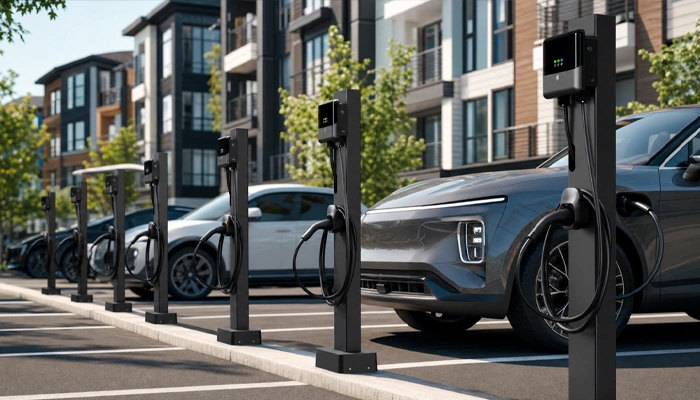
The occupancy effect compounds with tenant retention. Multiple property management sources note that EV charging functions as a retention lever: a tenant who has built a charging routine around a specific unit has a real switching cost to moving, which can support longer average lease durations and reduce turnover-related vacancy loss.
Why the Effect Is Accelerating in 2026
Several 2026-specific dynamics are pulling property value and occupancy effects forward faster than they otherwise would move:
- 1. Building codes are mandating what used to be optional. California's updated CALGreen requirements, effective January 1, 2026, require an EV-ready parking space for every unit in new multifamily construction, and extend EV-ready requirements to new hotels at 65% of parking spaces. Other high-growth metros, including Austin, have adopted similar EV-readiness codes for new construction.
- 2. Listings already show a market shift. Real estate trend data shows homes listed with EV charging as a feature increased 91.6% in 2025 versus 2024,evidence that buyers and their agents are actively searching for and marketing the feature, not just tolerating it.
- 3. Incentive timing is creating urgency, not just opportunity. The federal Section 30C Alternative Fuel Vehicle Refueling Property Credit,covering 30% of installation costs, with substantially higher dollar caps for commercial and multifamily projects, is set to expire for property placed in service after June 30, 2026. Owners weighing whether to install now versus later face a real near-term cost difference.
- 4.Supply is still thin relative to demand. With only an estimated 5% of multifamily properties currently offering charging, properties that install now are differentiating in a market where the alternative,a building with no charging, is still the norm, not the exception.
What This Means by Property Type
|
Property Type |
Primary Value Driver |
Primary Occupancy Driver |
|
Multifamily / apartments |
NOI uplift from charging fees flows directly into the income-approach valuation |
Screening criterion for EV-owning renters; supports lease renewal |
|
Mixed-use / retail |
Differentiates the property for tenants whose customers value the amenity |
Longer dwell time and repeat visits tied to charging availability |
|
Office / workplace |
Supports Class A positioning and tenant retention at lease renewal |
Increasingly cited in tenant site-selection and RFP criteria |
|
Hospitality |
Hilton reports EV charging as its top-converting amenity filter on Hilton.com, ahead of pools and free breakfast |
BLLA data: 91% of EV drivers favor properties with charging; ~50% will not book without it |
Frequently Asked Questions
Does installing EV charging actually increase appraised property value?
The strongest peer-reviewed evidence comes from residential transaction data, homes near public charging sold for 3.3–5.8% more. For income-producing commercial and multifamily assets, the more direct and verifiable path is through NOI: charging revenue increases NOI, and value is calculated as NOI divided by the market cap rate, so a sustained increase in charging-related income flows through to appraised value the same way a rent increase would.
How much does EV charging actually increase NOI?
It depends on station count, pricing model, and utilization. Industry sources commonly cite roughly $50/month in net revenue per Level 2 station as a starting planning assumption, though this varies by market and should be validated against local data before underwriting a deal.
Is the property value effect different for multifamily versus single-family homes?
The Nature Sustainability study measured single-family and condo transactions. For multifamily and commercial assets, value is driven more directly through the income approach (NOI ÷ cap rate) than through comparable-sale premiums, since these are income-producing assets rather than owner-occupied homes.
Will EV charging incentives still be available after 2026?
The federal Section 30C tax credit is currently scheduled to expire for property placed in service after June 30, 2026. State and utility-level incentives vary and should be confirmed directly with local programs, as availability changes more frequently than federal policy.
Does the occupancy effect apply outside multifamily housing?
Yes, hospitality is currently the clearest example. Hilton has reported that EV charging is now its highest-converting amenity filter on Hilton.com, and Boutique & Luxury Lodging Association survey data found the large majority of EV drivers favor properties with charging, with a meaningful share saying they will not book a property without it.
External Citations
Liang, J., Qiu, Y., Liu, P., He, P., & Mauzerall, D. L. (2023). Effects of expanding electric vehicle charging stations in California on the housing market. Nature Sustainability.
SWTCH Energy — survey of 1,567 multifamily residents in Boston, Chicago, Los Angeles, and Miami/Tampa, published September 2024 (swtchenergy.com)
Skift / Hilton — Hilton's global head of sustainability on EV charging as Hilton.com's top-converting amenity, July 2025 (skift.com)
Boutique & Luxury Lodging Association (BLLA) — sponsored EV driver survey data, as cited in EV Connect industry reporting (evconnect.com)
EV Connect — A Property Manager's Guide to EV Charging (evconnect.com)
EV Connect — A Complete Guide to the ROI of EV Charging Stations (evconnect.com)
Pando Electric — How EV Charging Can Boost Property Value and Rental Income for Multifamily Buildings (pandoelectric.com) — vendor-sourced; flagged for fact-check
Blue Whale EV — 2026 EV Charging Trends: What Maryland and Virginia Property Owners Should Know (bluewhaleev.com)
Shaffer Construction — CA 2026 EV Charging Mandate: Key Changes (shaffercon.com)