How Fast OEM Customization Accelerates EV Charger Time-to-Market
Introduction
The EV charging industry is no longer competing only on power specs or software features. Increasingly, it is competing on speed and the companies that reach the market in months rather than years are doing so through a different development model entirely.
For EV charger brands, charge point operators, energy companies, and distributors entering the market, one question has become unavoidable: how fast can a market-ready charger be launched without sacrificing quality, compliance, or meaningful customization?
The pressure behind that question is structural. Certification rules evolve. Procurement windows open and close. In many regions, arriving twelve months late can mean missing an entire market cycle. Yet building a EV charger from scratch, hardware engineering, firmware development, certification, manufacturing validation, supply-chain coordination, remains a genuinely complex undertaking.
That is why more companies are reaching for a different path: fast OEM customization built on proven charging platforms. Rather than starting from a blank sheet, businesses adapt mature charger architectures for branding, regional compliance, and software integration, compressing timelines dramatically without reinventing a technical foundation that already works.
This article examines why EV charger projects frequently run over schedule, how OEM customization addresses the core bottlenecks, and what to evaluate when choosing a manufacturing partner.
Time-to-Market as a Strategic Capability
Several years ago, entering the EV charging market was largely an engineering challenge. Today, it is equally a timing challenge.
The industry is experiencing simultaneous pressure from multiple directions: accelerating EV adoption, rapid infrastructure deployment, evolving safety standards, growing software interoperability demands, and intensifying competition among suppliers. This creates a narrower launch window than most companies expect when they enter the sector.
A delayed product launch translates into missed tenders, lost distribution opportunities, delayed revenue, and higher engineering costs. For operators and infrastructure providers, delays can also impact deployment targets, partnership commitments, and funding milestones. Time-to-market is no longer just an operational KPI, it has become a strategic business capability in its own right.
|
In today's EV charging market, arriving twelve months late can mean missing an entire tender or deployment cycle. |
Why EV Charger Development Takes Longer Than Expected
Most companies entering the EV charging sector underestimate the development complexity. An AC charger may appear relatively simple compared with other energy technologies. In practice, it combines power electronics, embedded systems, communications software, compliance engineering, cloud integration, and industrial manufacturing and each layer introduces its own failure modes.
01 HARDWARE DEVELOPMENT
A charger is not simply an enclosure with a connector. PCB architecture, power module selection, thermal management, and safety protection logic all require engineering iteration. Even small hardware changes can cascade: adjusting enclosure geometry may affect heat dissipation, waterproofing, assembly processes, and certification outcomes simultaneously. Engineering iterations compound quickly into timeline slippage.
02 FIRMWARE AND SOFTWARE INTEGRATION
Modern chargers require coordination across embedded firmware, communication protocols, app connectivity, backend cloud integration, smart charging logic, and user authentication. OCPP integration is one of the most common bottlenecks, while the protocol is widely adopted, implementation complexity is routinely underestimated. Backend compatibility issues, transaction synchronization failures, and interoperability edge cases often require months of debugging before a product is reliably deployable.
Certification is not a final step, it is one of the longest phases in the development cycle, and for many projects it becomes the primary schedule driver. CE, ETL, UKCA and electrical safety requirements each involve testing, documentation, and market-specific regulatory alignment. A failed EMC test late in the project can force PCB redesign, shielding modifications, and multiple additional validation rounds, each adding weeks and unpredictable cost.
04 MANUFACTURING READINESS
Engineering completion does not equal commercial readiness. Tooling validation, supply-chain qualification, production SOP development, factory testing processes, and pilot run stability all require dedicated effort after the design phase ends. First-time charger projects frequently stall here: the product functions technically, but production yield, sourcing reliability, or throughput consistency remains unresolved. Manufacturing maturity is a second development project that often catches companies off guard.
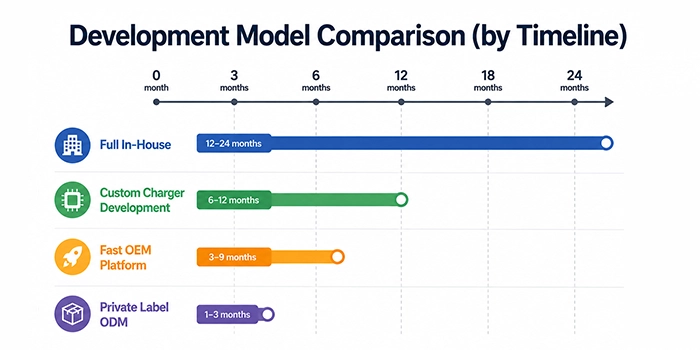
Development Model Comparison
|
Development Model |
Timeline |
Investment |
Eng. Risk |
Customization |
|
Full In-House |
12–24 months |
High |
High |
Highest |
|
Custom Charger Development |
6–12 months |
Medium–High |
Medium |
Medium–High |
|
Fast OEM Platform |
3–9 months |
Medium |
Lower |
High |
|
Private Label ODM |
1–3 months |
Low |
Lower |
Low |
Five Mechanisms That Accelerate OEM Timelines
Not every OEM project moves faster automatically. The real advantage lies in understanding which parts of the development process can be reused, modularized, or pre-validated. Effective OEM customization works through five specific mechanisms.
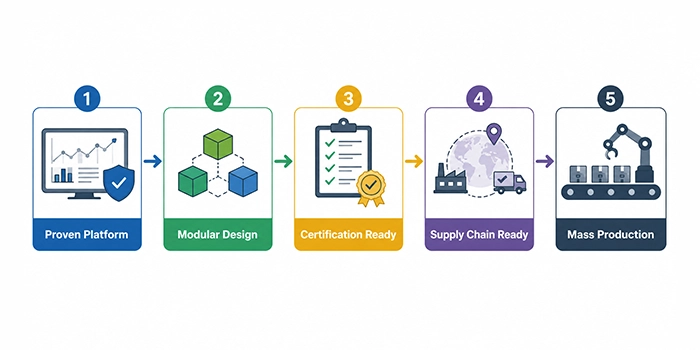
1. Platform Reuse: Eliminating Blank-Sheet Engineering
The single biggest timeline killer in EV charger development is starting from zero. A full in-house project requires teams to independently validate hardware architecture, communication stability, safety logic, charging behavior, thermal performance, and manufacturing feasibility. Each subsystem introduces unknowns.
Fast OEM customization shifts the question entirely. Instead of asking "Can this charger fundamentally work?" teams ask "How should this charger be adapted for a target market or brand strategy?" A mature OEM platform already includes stable power architecture, production-ready PCB design, tested firmware, and established component sourcing. These are known quantities, not open engineering problems. That difference can remove months of foundational development work before the project even begins.
2. Modular Architecture: Customization Without Full Redesign
A common assumption is that OEM customization means adding a logo to an existing EV charger. Sophisticated projects work differently, using modular design architecture to enable meaningful differentiation across multiple layers without triggering complete redesigns.
At the hardware layer, this may involve charging power configuration, connector standard selection, and enclosure adjustments. At the software layer, customization extends to app branding, RFID logic, and energy management integration. At the market layer, projects adapt for language localization, grid requirements, and regional compliance. A modular platform makes all of this possible while reusing the core electronics that would otherwise require the longest development and certification effort.
3. Certification Acceleration Through Prior Validation
Certification influences development, not just the final validation stage. A platform with prior certification exposure carries established compliance design practices, validated component selection, known EMC behavior, and documented testing experience. This does not mean certifications transfer automatically, market requirements vary, and testing remains necessary. But engineering teams working from previously validated foundations face lower technical uncertainty during compliance preparation, which measurably reduces the risk of late-cycle redesign that derails launch schedules.
4. Supply Chain Maturity: Eliminating the Hidden Bottleneck
Supply chains are frequently the hidden schedule driver in EV charger projects. Power semiconductors, relays, communication modules, cable assemblies, and enclosure components all carry their own lead time and sourcing risk. A technically complete charger that cannot be manufactured reliably at scale is not commercially ready.
Experienced OEM manufacturers already maintain qualified supplier ecosystems, alternate sourcing strategies, and procurement forecasting processes. This operational maturity helps companies avoid one of the most common market entry failures: engineering success followed by production paralysis.
5. Manufacturing Readiness: Compressing the Second Development Phase
Commercial deployment requires repeatability. Factories must consistently deliver assembly quality, testing accuracy, stable yields, and scalable throughput. Companies building independently often discover that manufacturing readiness becomes a second development project with its own multi-month timeline.
Fast OEM customization can shorten this phase by leveraging existing production infrastructure — SOPs, automated testing processes, quality inspection systems, and pilot production experience. For businesses operating under tender deadlines or infrastructure rollout targets, this compression can be the decisive commercial advantage.
|
The most effective OEM partnerships don't just save engineering effort. They eliminate entire categories of first-generation risk. |
Common Pitfalls Even in OEM Projects
OEM customization accelerates development, but not every project runs smoothly. Several issues commonly extend timelines even within OEM models, and recognizing them early helps set realistic expectations.
The most frequent problem is misalignment on customization boundaries. Some suppliers support only cosmetic branding; others enable deeper hardware and software modification. Misalignment at the quotation stage creates expensive delays later. Project teams should clarify hardware customization scope, firmware flexibility, software ownership, and certification responsibilities before contracts are signed.
OCPP compatibility is another area where assumptions consistently outrun reality. Protocol support is often treated as a checkbox feature, when in practice different deployments require backend interoperability validation, custom charging logic, and firmware management workflows specific to their network. Verifying practical implementation capability, rather than relying solely on protocol claims, is essential.
Finally, over-customization is a counterintuitive but genuine risk. Extensive redesign requests can effectively transform an OEM project into a new product development program, eliminating most of the timeline advantage. The most successful OEM projects identify clearly which elements require differentiation and which can safely leverage proven platform standards. Strategic customization consistently produces better launch outcomes than unlimited customization.
Choosing the Right OEM Partner
Selecting an OEM partner is not a sourcing decision. It is a development decision. The wrong partner increases engineering complexity rather than reducing it.
Product platform maturity is the first criterion. A commercially deployed, production-validated platform with an existing certification record and a mature firmware ecosystem is fundamentally different from a platform that exists mainly in prototype form. The difference in development uncertainty is substantial.
Engineering capability across hardware, firmware, OCPP integration, and certification support is the second. Customization speed depends entirely on the depth of the engineering team backing the platform, not just its specifications.
Regulatory experience matters more than most buyers initially expect. CE, ETL, UKCA, and regional electrical requirements involve nuanced compliance decisions that experienced manufacturers navigate more efficiently and at lower risk. Compliance preparation quality directly influences launch schedule reliability.
Manufacturing capability and supply-chain resilience determine whether a successful development project can actually reach commercial scale. And finally, customization responsiveness, how efficiently the supplier manages change requests, technical communication, and project execution, is as important as the technical platform itself. OEM speed is not only technical. It is operational.
Speed Without Reliability Is the Wrong Goal
In EV charging, moving faster is valuable, but speed without reliability creates different risks. A EV charger launched quickly but plagued by certification failures or manufacturing instability can ultimately cost more time and money than a slower, well-executed project.
The objective is not reducing development months for their own sake. It is achieving faster commercialization with controlled engineering risk. For many organizations: distributors, energy companies, electrical brands, charging operators, and infrastructure providers that balance is precisely what fast OEM customization delivers.
The competitive question has shifted. It is no longer “Should we build everything internally?” It is “Which parts of development truly create differentiation= and which are more efficiently accelerated through a proven platform?” The answer varies by company. But for businesses primarily seeking faster market entry, private-label products, and reliable customization at scale, OEM development increasingly offers the more practical path.
|
In today's EV charging industry, launching the right product at the right time may matter just as much as launching the most technically ambitious product. |
Ready to bring your EV charger product to market faster?
ULandPower supports OEM and ODM EV charger projects across residential and commercial applications from hardware design and firmware integration to certification and manufacturing scale.
- AC & DC chargers: 7 kW – 240 kW
- Full hardware customization: enclosure, PCB, power module
- Firmware & software integration, OCPP 1.6J / 2.0.1
- Private label & white label ready
- Certified: CE / CB / UKCA / ETL / FCC
www.ulandpower.com · info@ulandpower.com
Table of Contents >
- 1. Introduction
- 2. Time-to-Market as a Strategic Capability
- 3. Why EV Charger Development Takes Longer Than Expected
- 4. Five Mechanisms That Accelerate OEM Timelines
- 5. Common Pitfalls Even in OEM Projects
- 6. Choosing the Right OEM Partner
- 7. Speed Without Reliability Is the Wrong Goal
- 8. Ready to bring your EV charger product to market faster?